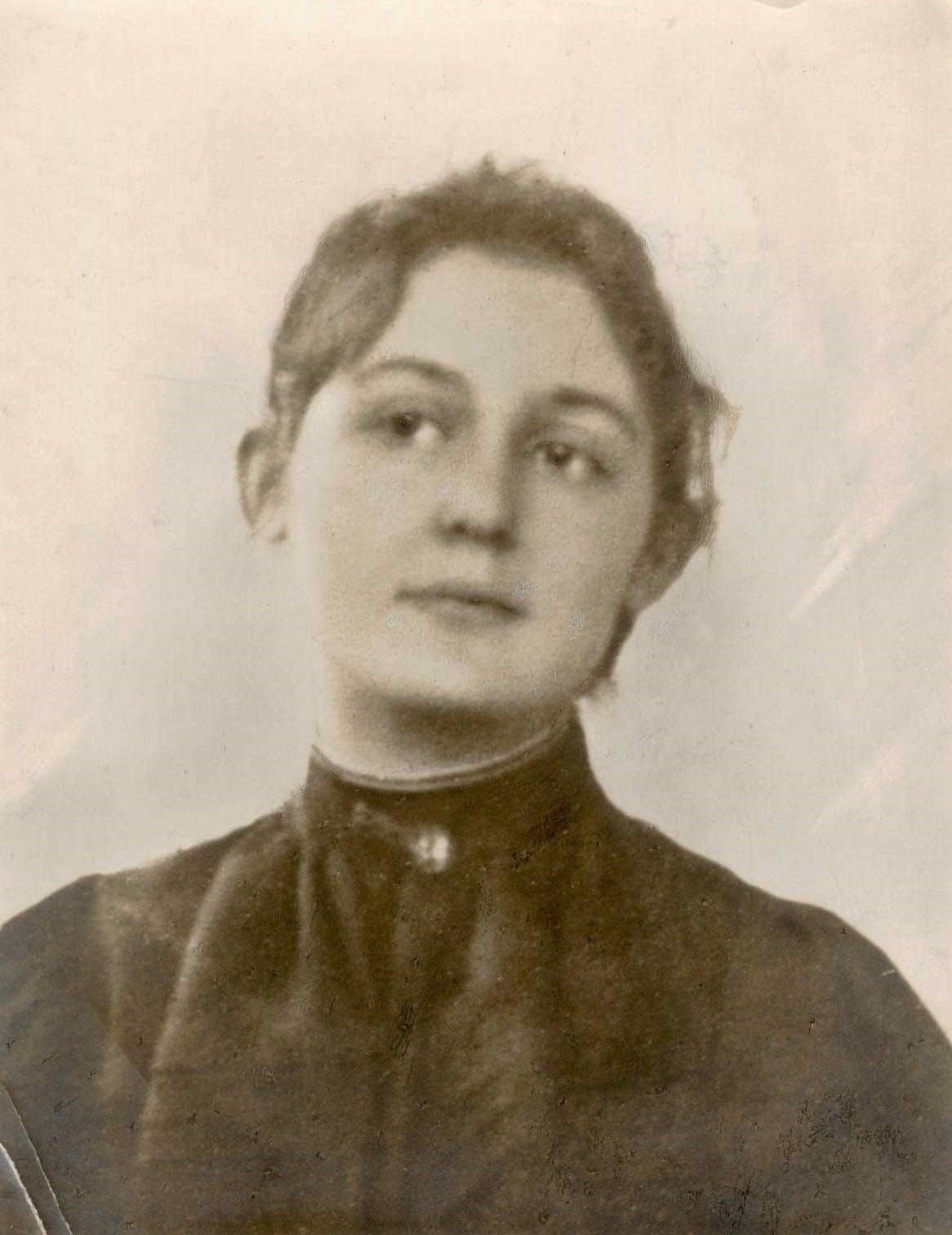
Murdered by the Nazis, her colour theory book burnt, Carry van Biema was in danger of being entirely forgotten. But new research by a group of dedicated academics should change this, enabling her work to once again get the attention it deserves.
Outside of academic circles, there is so little written about van Biema it is tempting to believe that the Nazis succeeded in obliterating her legacy. There is a scant autobiographical outline; born in Hanover, Germany, in 1881, Karoline 'Carry' van Biema was a talented artist. She attended the Academy of Fine Arts in The Hague before studying under Adolf Hölzel, a German abstract painter who taught at the State Academy of Fine Arts Stuttgart. Van Biema went on to mix in artistic circles in both Germany and Holland.
Hölzel's ideas around colour theory fascinated van Biema and had a lasting influence on both her paintings and writing. Building on Goethe's earlier ideas about emotional and psychological responses to colour, he had developed a 12- part colour wheel, ascribing primary importance to purple for the creation of colour harmonies. He drew parallels between colour and music and was interested in exploring how line, shape, dark and warmth could affect artistic composition. (Hölzel also mentored Johannes Itten, who went on to teach colour at the Bauhaus).


Left & Right: Farben und Formen als lebendige Kräfte (Colours and Shapes as Living Forces), 1930. Both photos courtesy of Alexandra Loske.
Hölzel hadn’t recorded any of his theories and initially it seems that van Biema‘s intention was to bring his teachings to a wider audience. She was a dedicated educator, teaching throughout her adult life. In 1930 van Biema published her groundbreaking colour book, Farben und Formen als lebendige Kräfte (Colours and Shapes as Living Forces). The book was broadly divided in three sections; a primer on painting and composition, and an introduction to the colour theories of both Goethe and Hölzel.
Colour theory is often complex and difficult to understand; van Biema’s genius lay in her ability to decode these ideas. She used chromolithographic plates with a transparent sheet printed with shapes and texts that were overlaid onto the image below, simple and highly effective. Not everyone approved, Hölzel was notably underwhelmed, dismissing the book as 'Painting instructions for maids.' (1) But it was well received and sold, bringing van Biema critical success.


Left: Adolf Hölzel self portrait 1887. Centre: Head of a girl looking down to the right. c.1933-38 © The Trustees of the British Museum. Right: Mother & Child 1930.
During this time, van Biema didn't neglect her art. In 1933 she moved to Barcelona, taking part in her first solo art show, before returning to the Netherlands in 1938. By 1940, Nazi Germany had occupied the region, and the systematic persecution of Dutch Jews began in earnest. First her book was banned and existing copies burnt. Then in 1942 she was deported to Auschwitz concentration camp where she was murdered on arrival.


Centre: Original publication of Farben und Formen (1930), from the collection of Alexandra Loske. Photo courtesy of Alexandra Loske. Left & Right: Stolpersteins for van Biema. Right: Photo Christian Michelides.
Two brass plaques commemorating her life have been laid in pavements in Utrecht, Netherlands and Hildesheim, Germany, part of the ongoing Stolpersteine project by artist Gunter Demnig. The former marks the last place that van Biema lived before she was deported. Farben und Formen was republished in 1997. Now a raft of research on van Biema is being undertaken by Alexandra Loske in the UK, Ed Charbonneau in the US and Francisca van Vloten in the Netherlands. Loske included an entire chapter to van Biema in TASCHEN’s The Book of Colour Concepts, published in 2024 and 2025, and dedicated an academic volume on colour history (A Cultural History of Color in the Age of Industry, Bloomsbury 2021) to van Biema. It is fitting that a book and life ruthlessly suppressed by the Nazi regime is now gradually being reinstated to its rightful place in the history of colour theory.
Sources: 1. Color ordered: a survey of color order systems from antiquity to the present. Rolf G. Kuehni; Andreas Schwarz. New York ; Oxford : Oxford University Press, 2008. The Book of Colour Concepts, Alexandra Loske, published by TASCHEN. With thanks to Alexandra Loske for her expert guidance on this feature.